
This year’s focus was on the metaphysics of free will and brought together several of the leading figures on these topics: Mark Balaguer (California State University, Los Angeles), Dana Nelkin (University of California, San Diego), Derk Pereboom (Cornell University), Carolina Sartorio (Rutgers University), and Jason Turner (University of Arizona).
Upcoming Events at the Freedom Center
Join us for thought-provoking lectures, discussions, and workshops on philosophy, politics, economics and law.

- This event has passed.
Arizona Workshop on Freedom & Responsibility
November 7, 2025 - November 8, 2025

More about the Workshop
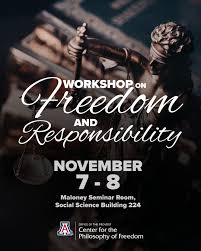
Workshop Details:
The Arizona Workshop on Freedom & Responsibility was held at the Social Sciences Building, Rm 224, in Tucson, AZ on November 7 – 8.
Summary of Speakers
There has been much recent discussion of whether and, if so when, people possess standing to respond to wrongdoing in various ways, notably by blaming and forgiving. Theorists disagree about a number of claims, including how best to understand the nature of standing, under what conditions it is undermined, whether it applies to the mere possession of certain attitudes, and more.
In this paper, I identify a number of extant arguments and conclusions that I think are correct, but have not been put together in a single package. When they are, I believe they provide mutual support and illumination. In particular, I endorse a picture that incorporates a conception of standing as a normative power modeled after the notion of standing in the law, supports the existence of a central kind of forgiveness as a kind of debt release, offers a plausible account of the relationship between blaming and holding accountable, explains why blame seems to come in degrees where forgiveness of an important sort does not, and explains an asymmetry in debates about hypocrisy and “meddling”. I conclude by exploring implications for debates about self-blame and the standing of the state.
Frankfurt (1969) examples contest an alternative possibilities requirement for moral responsibility. But as I will argue, Frankfurt examples do not rule either general or, as Nelkin argues (2011), certain special abilities to do otherwise as such requirements. However, it remains open that they successfully contest the notion of an alternative possibility at stake in the free will debate.
Randolph Clarke suggests that Frankfurt examples instead contest the requirement that it be up to the agent to exercise that ability, or that it be the agent’s choice to exercise that ability (Clarke 2009). I propose, further, that the conceptually distinct notion of an agent’s having access to the alternative specified in such abilities to do otherwise is successfully targeted, and that this notion of access also illuminates other controversies in the free will debate.
The luck objection to libertarianism about free will states, somewhat roughly, that if a decision is undetermined in the way that’s required for libertarian free will, then it occurs randomly and, hence, isn’t free in any robust sense.
This paper argues for the contrary claim that if decisions are undetermined in the relevant way, then they satisfy all of the other requirements for libertarian free will. The paper provides a new argument for this claim that doesn’t require libertarians to make any additional assumptions.
In Freedom & Responsibility in Context, Ann Whittle argues for a contextualism about abilities according to which, essentially, X is able to A iff X has both the “all-in” ability to A and the opportunity to try to A, where contextual variation shifts what counts as an opportunity to try to A.
Combined with an alternative-abilities-based account of freedom and moral responsibility, this delivers a framework where arguments for incompatibilism generally fail, but succeed in appropriately high-standards contexts.
In this talk I raise several issues about (i) the linguistic evidence for contextual variation of this sort; (ii) the relevance of claims such as “X is able to A” to core philosophical claims about an agents’ abilities; and (iii) the downstream philosophical consequences if the thesis is true.
Unlike basic responsibility, non-basic responsibility is a kind of responsibility that is inherited (from our responsibility for something else). The question I’m interested in examining in this paper is this: Should we still expect these two forms of responsibility to be unified in some significative way? Is unification an advantage of a theory of responsibility?
Some (notably, van Inwagen, Fischer and Ravizza, and Capes) have thought so. I argue against unification. I then draw consequences for some debates about the ability to do otherwise.
All talks will be held in the Maloney Seminar Room, Social Science Building 224 on the University of Arizona Campus. There will be no remote option for the Saturday talks.
Organized by Michael McKenna (msmckenna63@gmail.com).
*This workshop is generously funded by the Center for the Philosophy of Freedom.
Special thanks to Mary Rigdon, Center Director, for her support!

