

By Jacqueline Valenzuela-Gil, Freedom Center Student Marketing Assistant
This year’s Hack Arizona brought together over 100 students in a fast-paced environment centered around creativity, technology, and collaboration. Walking into the event, one of the first things that stood out to me was the atmosphere. Students, all with different majors, interests, and gameplans coming together to share the experience and bring their own ideas to this well organized and concretely impactful competition.
The dedication of the participants was impossible to miss. Many students arrived with sleeping bags and stuffed backpacks prepared for a full night of work and fully expecting to get little to no sleep while developing their projects. There was a very real sense of excitement in the air, and even before the competition had begun you could hear groups brainstorming ideas or approaching peers and mentors for advice. I had never been in an environment that felt so enthusiastically competitive and still managed to keep good spirited collaboration ever present.
The Team Behind the Event
The Center for the Philosophy of Freedom participated as a “Bear Down” Sponsor for the event with the Office of the Provost. The Center extends its thanks to both the student leaders organizing the event and the Office of the Provost for their support. We’re proud to encourage students with bright ideas and determination powering them through the night.
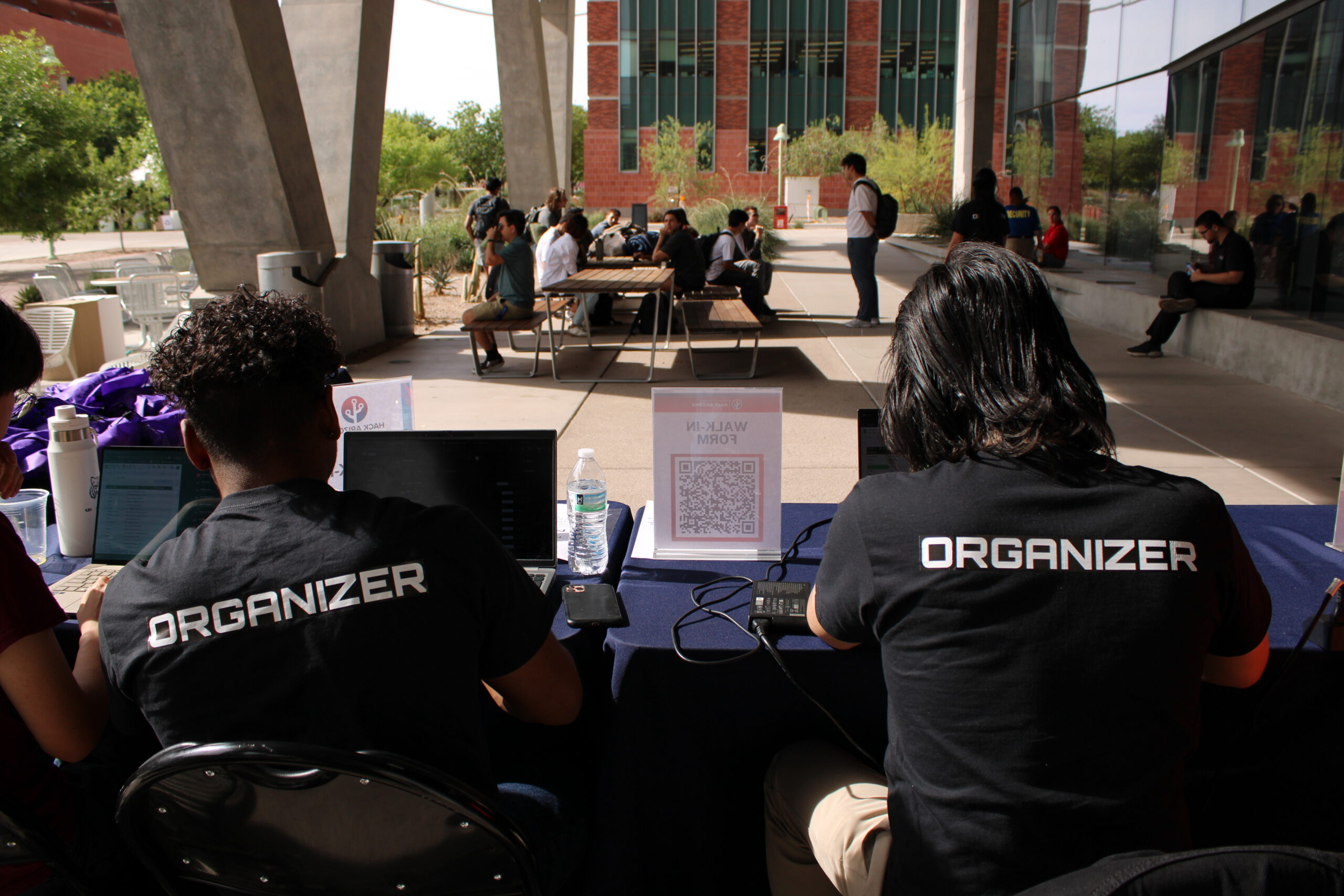
One of the most impressive aspects of Hack Arizona was that the event itself is student-run. I saw several members of the Hack Arizona team there throughout the day and they seemed just as dedicated, excited, and occupied as the contestants. They were out helping students with their work, coordinating sponsors, educators, and mentors, bringing snacks and food in for contestants, and doing much more to support the students and keep everything running as smoothly as it could.
Hack AZ originally began in 2015 through the efforts of students from academic units across the university, including the Department of Computer Science, the School of Information, the Eller College of Management, the College of Fine Arts, and the College of Social and Behavioral Sciences. It has since grown into the one of the largest hackathons in the Southwestern United States, pausing during the COVID-19 pandemic, but returning with a bang in 2025, and the current team is hard at work honoring the dedication of past organizers while rebuilding the hackathon in a thoughtful and sustainable way.
The Competition This Year
This year the challenge tracks encouraged students to apply technology and creativity toward solving real-world problems affecting both local and global communities. While each track focused on a different issue, they all shared the broader goal of using innovation to actually improve people’s lives in meaningful ways.
The Social Innovation tracks focused on connecting students, nonprofits, and community organizations to develop practical solutions for challenges affecting communities across Southern Arizona. Organized in partnership with the Tucson Poverty Project and sponsored by the Freedom Center, the Improving Workforce Training Completion for Individuals Facing Barriers to Employment challenge was all about finding ways to help individuals complete workforce training programs despite facing obstacles like housing instability, transportation difficulties, or caregiving responsibilities.
Participants were tasked with designing solutions that could support people throughout workforce training programs while respecting individual dignity, privacy, and autonomy. There were two winners in this challenge. Own Path, a scalable web-application that helps workforce training participants stay on track through simple SMS check-ins, while giving staff AI-powered insights to offer the right support, on the participant’s terms, won a cash prize for the Best Preservation of Individual Autonomy. And Community Food Bank, a system that seamlessly integrates between P2 and Azuro, the applications that the Community food bank of Southern Arizona uses for daily organizational tasks, won their own cash prize for Most Innovative Use of AI for the Public Good. Dr. Mary Rigdon, Freedom Center Director and Associate Professor of Political Economy and Moral Science at the University of Arizona College of Social and Behavioral Sciences, joined for the closing ceremony on Sunday offering remarks congratulating the participants and handing out the awards.

“Turning caffeine into code (or policy, or design) is no small feat...apply what you are learning [here] to real-world challenges. Whether your background is engineering, business, public policy, design, computer science, or the social sciences, your perspective matters. Thank you for being part of this important work, and thank you for helping shape a stronger future for Southern Arizona — one hackathon project (and late-night ideas) at a time.”
Dr. Mary RigdonHackathon Awards Presentation Remarks

An Inspiring Environment
The event also offered a wide range of workshops led by professionals in their respective fields, giving students the opportunity to hear new perspectives and receive guidance directly from experienced individuals working in technology and innovation. One of these workshops was presented by the Freedom Center. The Silicone Sample, a presentation given by Freedom Center Visiting Fellow Dr. Monica Capra, Director & Co-Founder of EconLLM Lab at Claremont Graduate university, and Kseniia Biriukova, Graduate Researcher, Arizona State University, W.P. Carey School of Business; covered the typical cultural alignment of learning language models and the importance of understanding the cultural bias these models may have.
Overall, Hack Arizona 2026 created an energetic and inspiring environment that emphasized collaboration, learning, and innovation. From students sleeping under tables to finish projects, to workshops led by professionals, to final presentations in front of judges, the event showcased the passion and creativity of the University of Arizona community. Hack Arizona 2026 couldn’t have happened without coding and technology, but the event was just as much about teamwork, problem-solving, and building a space where students from different backgrounds could come together and create solutions with real-world impact.

